
How Much Does Digital Marketing Cost for a Small Business in 2026?
Ask three agencies what digital marketing services cost and you'll likely get three very different answers. One quotes $500 a month, another says $2,500, a third comes back at $5,000. Ask why, and the explanations tend to get vague fast: "comprehensive strategy," "full-service approach," things that sound nice but don't actually explain the gap.
The honest answer is that it depends. That's true, but it's not useful on its own, especially if you're trying to compare quotes from different providers or figure out whether an online marketing agency is even the right move for your budget right now. Here's what digital marketing services actually cost in 2026, broken down by what you're paying for.
Why There's No Single Price Tag
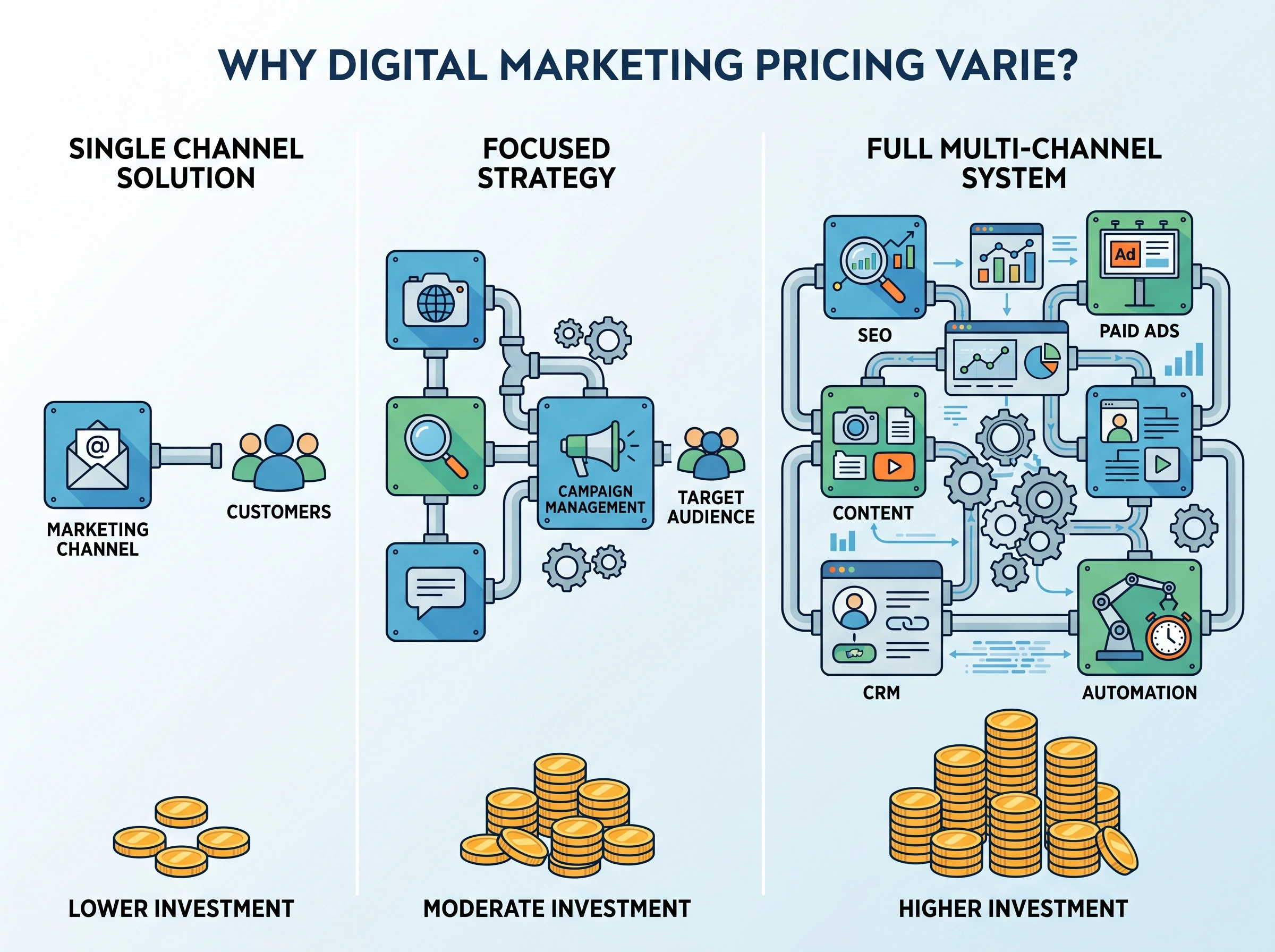
Cost comes down to three things: how many services are bundled together, how competitive your industry and market are, and whether things like automation and CRM setup are included or billed separately. A single-channel engagement, paid ads only, for example, costs less than a full-service package covering SEO, content, paid media, and automation all at once.
This is also why comparing a freelancer's rate to a full online marketing agency's retainer rarely tells you much on its own. A freelancer might charge less per hour, but an agency typically brings a team of specialists, established processes, and tools that would take months to build from scratch on your own. Neither is automatically the better choice. It depends on how much you actually need done and how fast.
The ranges below reflect typical U.S. small business pricing in 2026. Think of them as a way to sanity-check a quote, not a guaranteed price for your specific situation.
Typical Cost Ranges by Service (2026)
SEO: Local SEO for a small service business typically runs $750 to $3,000 per month, covering on-page optimization, technical fixes, local citations, and ongoing content work.
Paid ads management: Professional management of Google Ads or similar platforms typically runs $1,000 to $2,500 per month. This is important: that's the management fee, not the ad spend itself, which is a separate budget line entirely.
Social media management: Typically $750 to $3,000 per month depending on how many platforms and how much content volume is involved.
Email and SMS marketing: Usually $300 to $2,000 per month, largely driven by platform costs and how much campaign creation is included.
Full-service packages: Bundled retainers covering multiple channels typically start around $1,500 to $3,000 per month for one or two channels, and run $3,000 to $7,500 for a genuinely multi-channel setup with SEO, paid ads, content, and reporting combined.
What Actually Drives the Price Up or Down
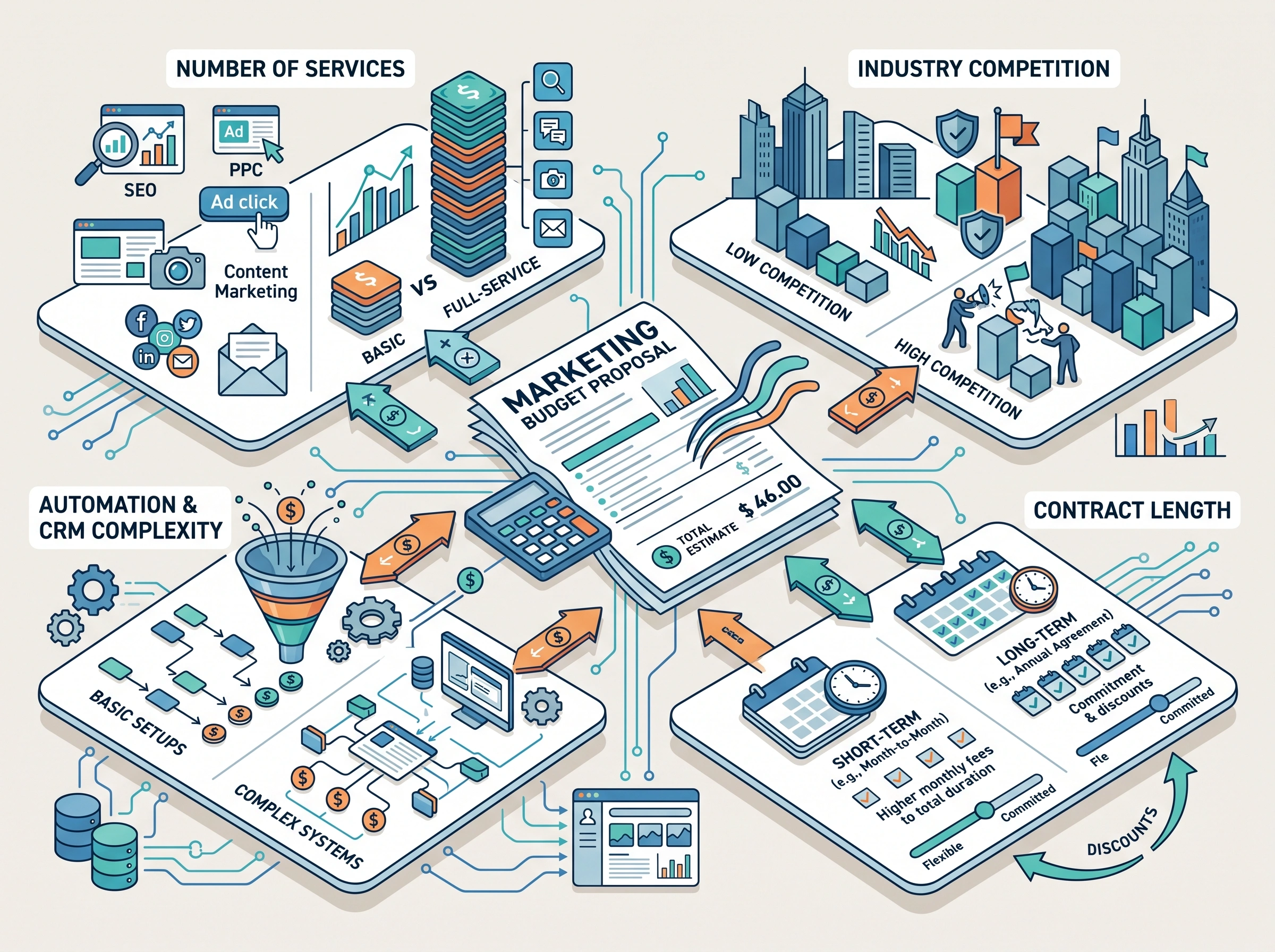
A few factors explain most of the variation between quotes:
Number of services combined. Bundling SEO, ads, content, and automation into one engagement is usually more efficient (and often cheaper per service) than buying each separately from different vendors.
Industry competitiveness. A crowded, high-value market (think legal services or home improvement) costs more to compete in than a niche with less competition.
Automation and CRM inclusion. Some agencies price automation and CRM setup as part of the retainer. Others treat it as a separate add-on. That difference alone can shift a quote by hundreds of dollars a month.
Contract length. Month-to-month agreements sometimes carry a premium compared to longer commitments, though that tradeoff comes with less flexibility if things aren't working out.
Hidden Costs Worth Watching For

Ad spend versus management fee. This is the single biggest source of sticker shock. A $1,500 monthly management fee is separate from the actual ad budget you're spending on Google or Meta. Some proposals blur this line, so always ask for the two numbers separately.
Software and platform fees. CRM software, ad platforms, and reporting tools sometimes get passed through as a separate line item rather than being folded into the retainer.
Onboarding or setup fees. A one-time setup charge for account access, tracking, and initial strategy work is common, and worth asking about upfront so it doesn't show up as a surprise on the first invoice.
Long lock-in contracts. A 12-month commitment with no easy exit is a real risk if the relationship isn't working. Ask what happens if you want to leave before the term ends, and get that answer in writing before you sign anything.
How to Get an Accurate Quote for Your Business

Before reaching out to an online marketing agency for a quote, have a few things ready: which channels you're currently using (if any), what your actual goals are (leads, sales, brand awareness), a rough budget range you're comfortable with, and how quickly you need to see results.
The more specific you can be upfront, the more accurate and comparable the quotes you get back will be. A vague request like "help us with marketing" tends to produce a vague quote in return. A request like "we need paid ads management and better lead follow-up, budget around $2,000 a month" gets you something you can actually evaluate against another agency's proposal.

Frequently Asked Questions
Is it worth paying for digital marketing as a small business?
For most businesses that depend on new customers finding them online, yes. The return depends heavily on execution, though. A well-run $1,500 a month engagement can outperform a poorly run $5,000 one, so the agency and approach matter more than the price tag alone.
What's a reasonable starting budget?
For a single channel done well (SEO or paid ads management alone), $750 to $2,000 a month is a reasonable starting range for most small businesses. A genuinely multi-channel approach usually starts closer to $3,000 a month.
Is ad spend included in an agency's fee?
Almost never. Management fees and ad spend are typically separate. If a quote doesn't clearly split the two, ask directly before signing anything.
Every business's situation is different enough that general ranges can only tell you so much. Get a scope-specific quote from GrokOn's digital marketing team based on your actual goals and budget, not a generic number.