blogs
Insights, Strategies & Systems to Grow Your Business
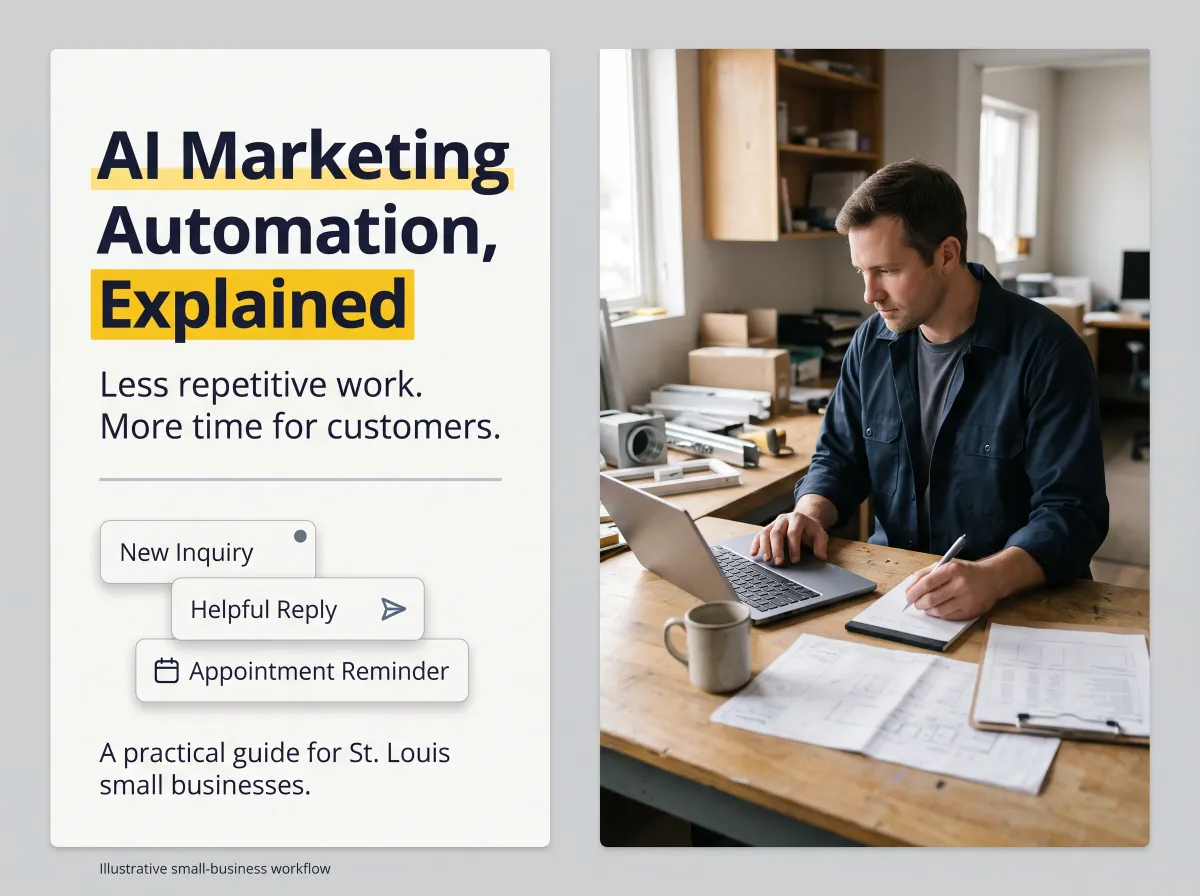
What Is AI Marketing Automation? A Plain-English Guide for Small Business Owners
AI marketing automation is software that handles repetitive marketing work, like replying to leads, sending follow-ups, and building reports, and uses artificial intelligence to adjust the message and timing for each person. For St. Louis businesses, AI marketing automation for small business comes down to one idea: fewer leads slipping away.
Stop Losing Leads to Busy Days and Late Nights
Most small businesses don't lose leads because they don't care. They lose them because the crew is on a job, the office closed at five, and nobody saw the form until morning. By then, the homeowner booked whoever answered first. That gap is a revenue leak, and it adds up fast.
And AI can feel like one more thing to figure out. The headlines are loud, the vendors make big promises, and it's hard to tell what's real. This guide skips the hype. It explains what AI marketing automation actually does, what to automate first, and where people still matter most.
Understand AI Marketing Automation in Plain English
Marketing automation has been around for years. It sends an email when someone fills out a form, or a reminder when an appointment is coming up. AI adds prediction on top of those rules, helping choose what to say, who to say it to, and when, based on how each person behaves.
Think of it as the difference between a printed schedule and a sharp assistant. The schedule does exactly what it says. An assistant notices a customer has opened your estimate three times and nudges you to follow up. AI marketing automation aims to behave more like the assistant.
See How It Differs From Regular Automation
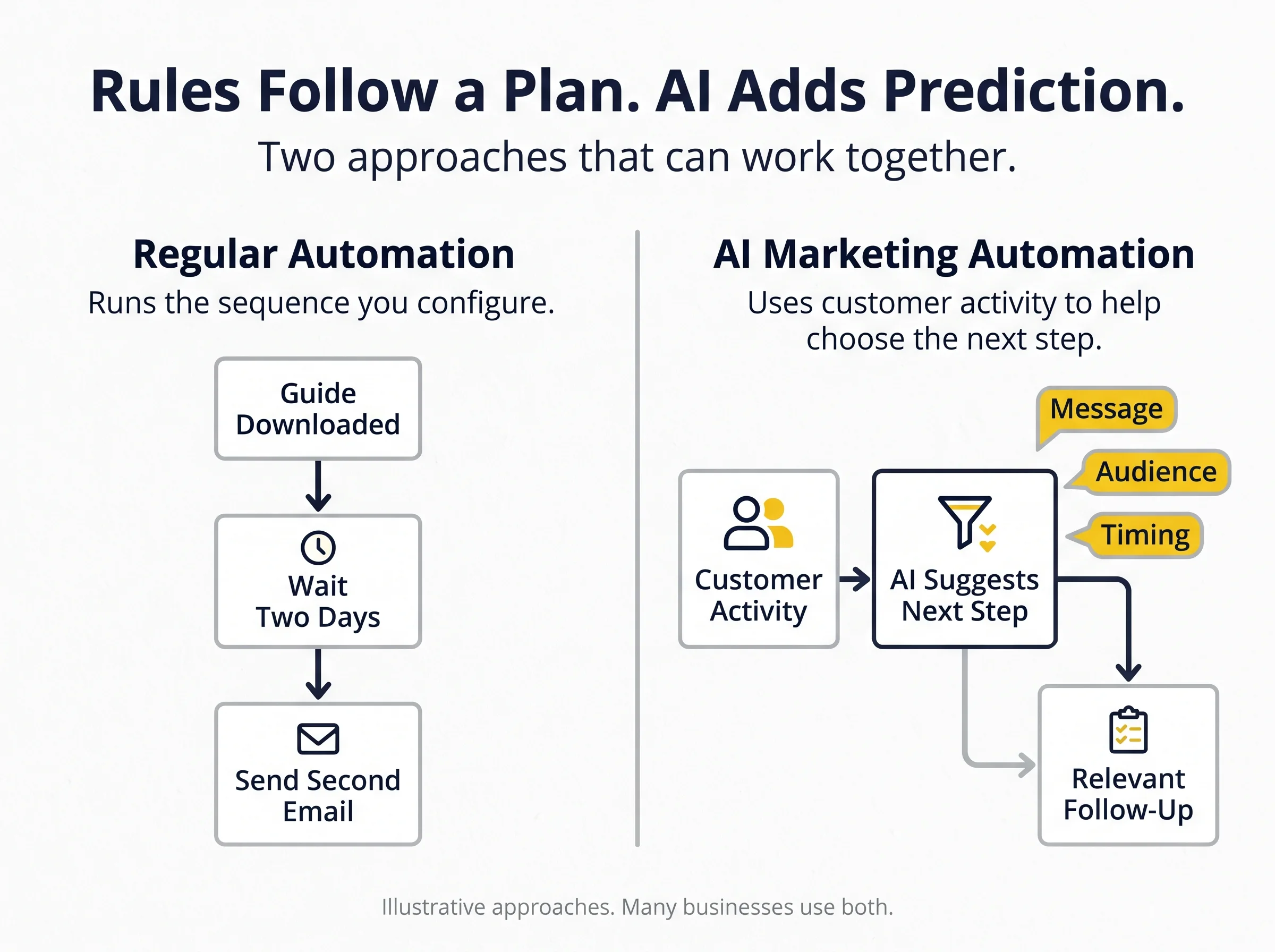
Regular automation is a flowchart you draw yourself. If someone downloads a guide, wait two days, then send the second email. It runs exactly as written until you change it. That works well for predictable steps, but it treats every customer the same way, every single time.
Regular automation: follows rules you write, repeats them the same way for everyone, and changes only when you edit it
AI marketing automation: adjusts timing, message, and audience based on what each person does, and improves as it sees more results
Know What It Can Actually Do for You
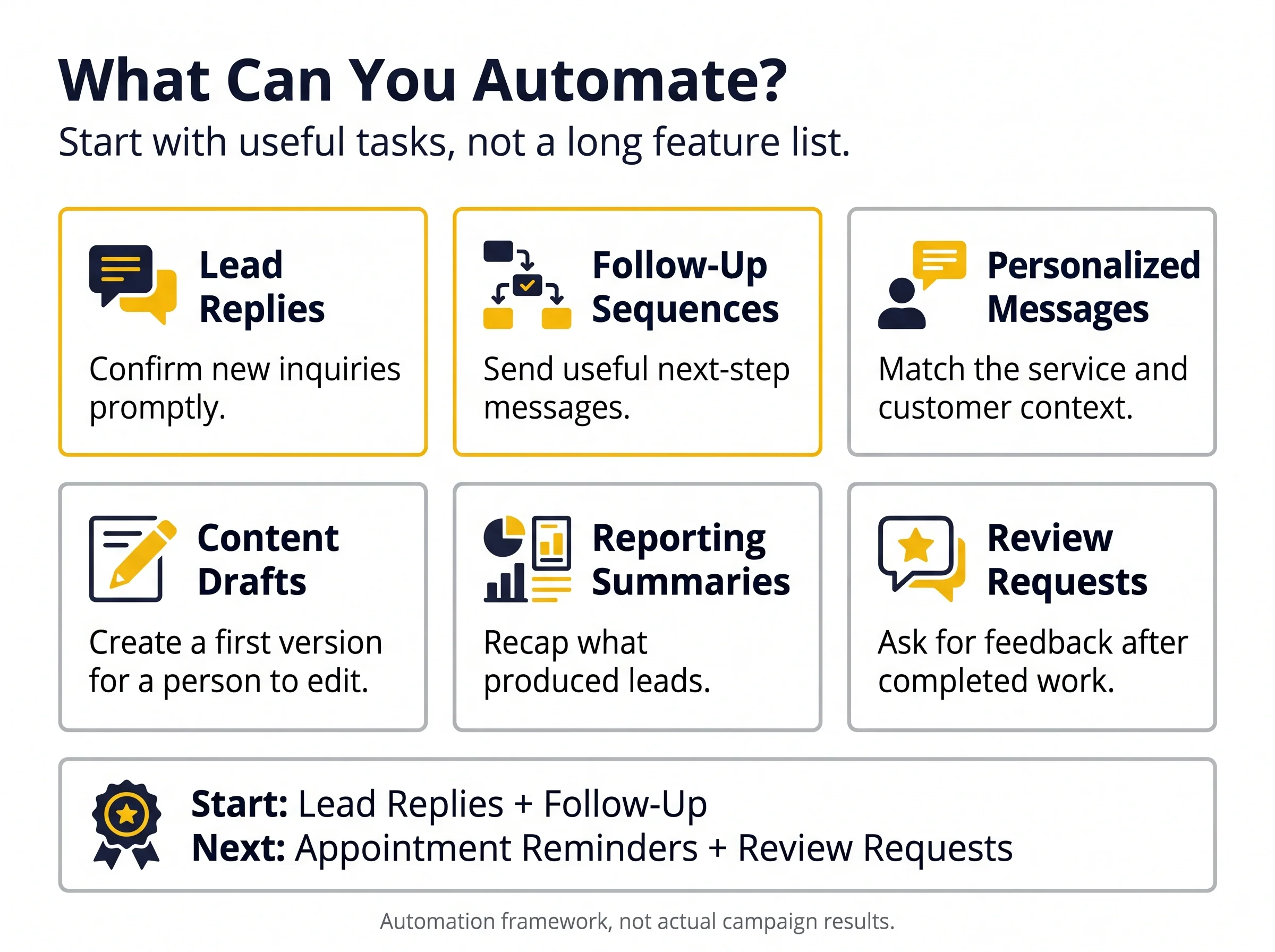
Most small businesses use a handful of practical functions, not a long list of advanced features. These are the ones that matter most for a business that runs on inquiries, estimates, and repeat customers, and each one takes a task off someone's plate that's currently done by hand.
Instant lead replies: a friendly first response within minutes, day or night
Follow-up sequences: timed emails and texts that continue until the lead answers or opts out
Personalized messages: wording and offers matched to what each person looked at
Content drafts: first versions of emails, posts, and captions for a person to edit
Reporting summaries: plain-language recaps of what produced leads this week
Review requests: a short ask sent after each completed job
Automate the Work Closest to Revenue First
Start where the work sits closest to revenue. For most local businesses, that means lead response and follow-up. A prompt reply often decides who gets the job, and it's the task most likely to slip when the crew is busy and the phone keeps ringing.
Next, automate reminders and review requests. Appointment reminders cut down on no-shows, and a review request sent right after a good job catches customers while they're happy. Both are simple, repeatable, and low risk, which makes them a comfortable second step before anything more advanced.
See It Working for a Local Service Business
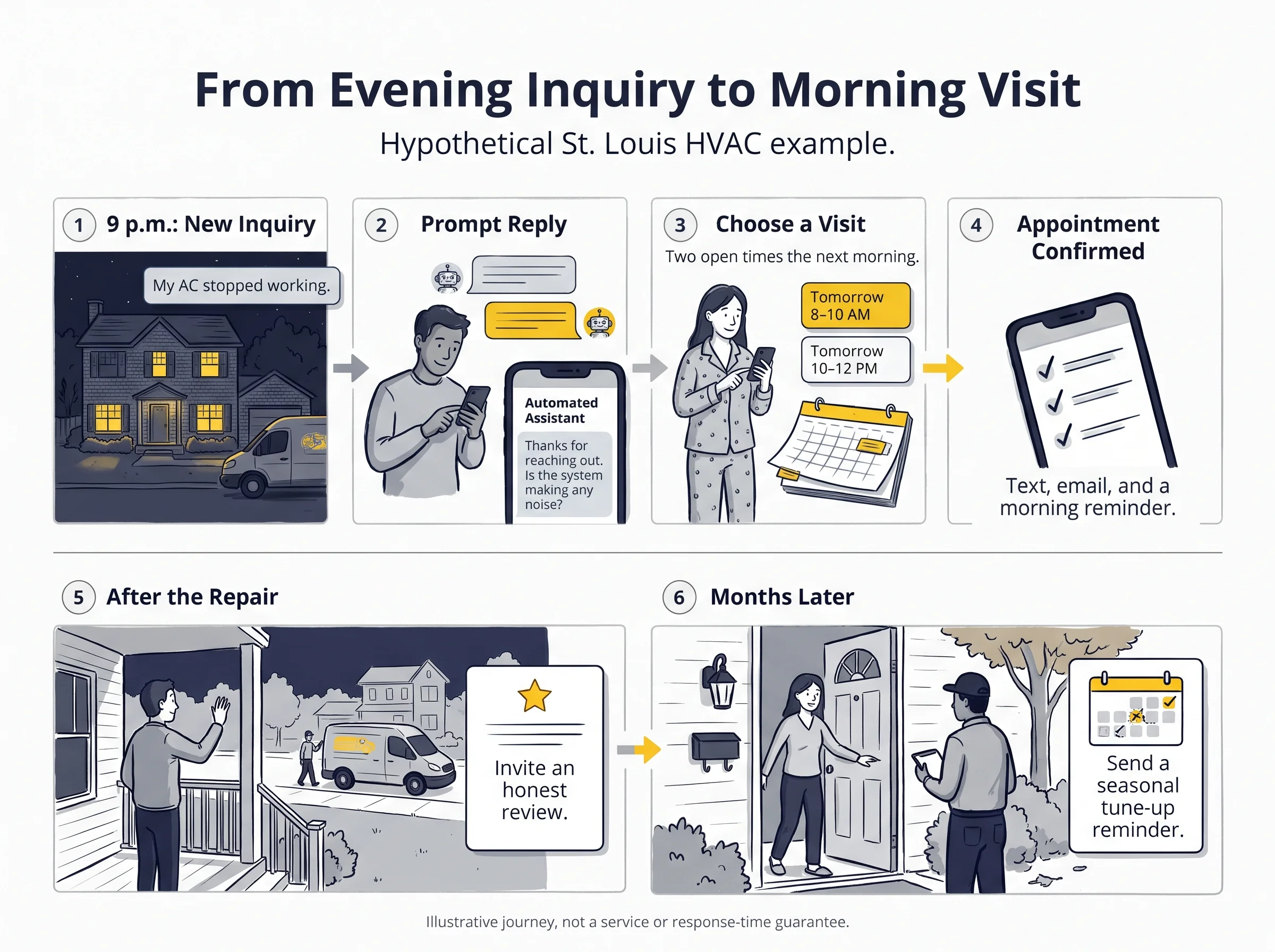
Picture a hypothetical St. Louis area HVAC company. At nine on a hot evening, a homeowner fills out a form saying the air conditioner stopped working. Nobody's in the office, but within a minute the homeowner gets a friendly text confirming the request and asking one question: is the system making any noise?
The answer helps sort the request, and the system offers two open times the next morning. The homeowner picks one and gets a confirmation by text and email, then a reminder the morning of the visit. The dispatcher starts the day with the booking already on the calendar.
After the repair, a short message asks how it went and includes a link to leave a review. Months later, a seasonal reminder invites the customer to book a tune-up. Nobody typed any of those messages by hand, yet each one felt timely and personal to the homeowner receiving it.
Keep a Real Person Where Judgment Matters
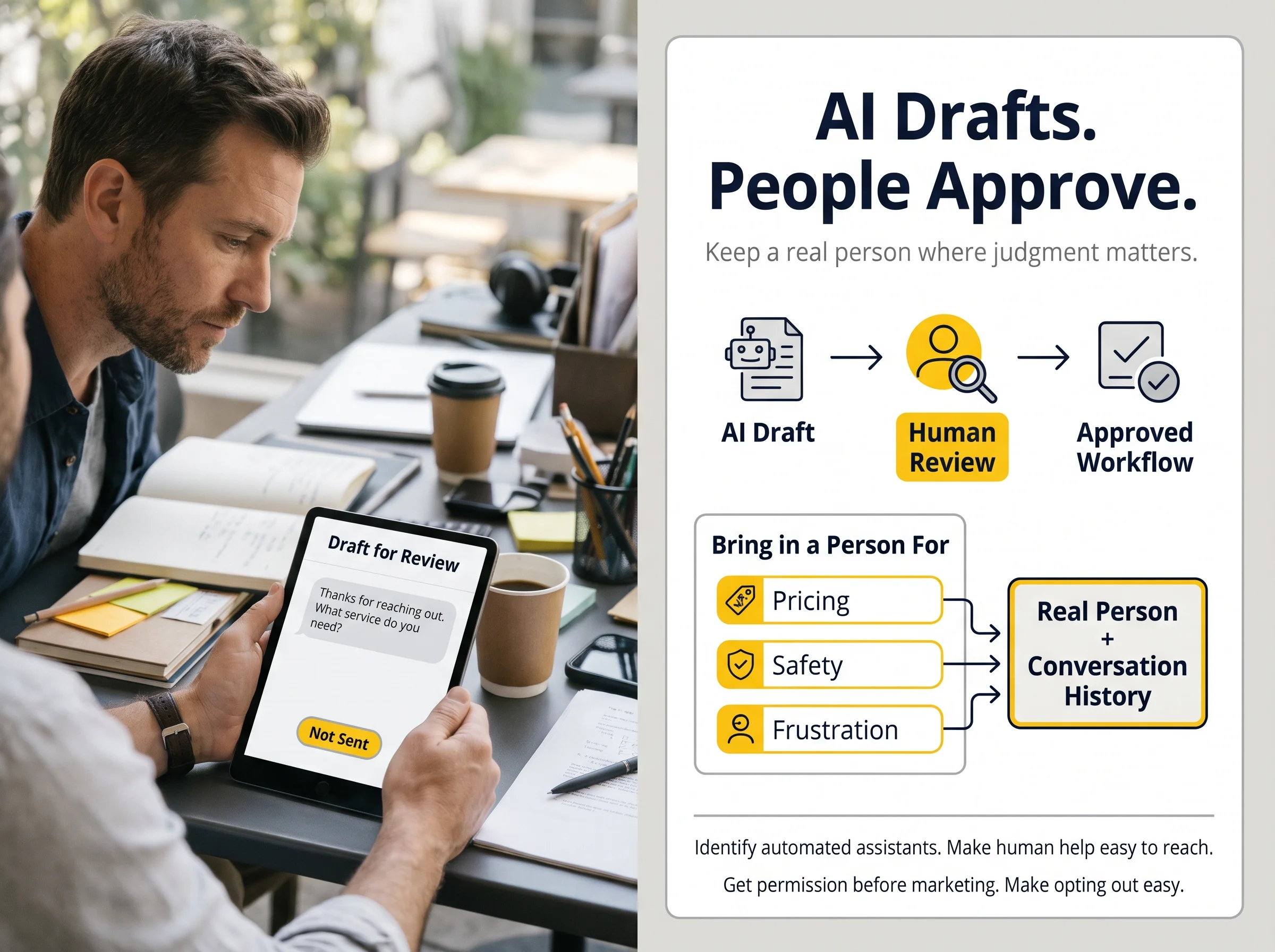
AI is great at speed and consistency. It's less reliable at judgment, nuance, and accuracy. It can misread a message, repeat a wrong detail, or sound slightly off. For anything involving pricing, safety, or a frustrated customer, a real person should be able to step in quickly.
A practical rule: AI drafts and people approve. Review messages before they go live, test them yourself, and check a sample every few weeks. Customers forgive an automated reminder, but they don't forgive being ignored or misled, so always keep an easy path to a real person.
Avoid the Mistakes That Make Automation Backfire
The most common mistake is automating a process that's already broken. If leads are unclear, handoffs are messy, or nobody owns follow-up, automation just repeats the mess faster. Fix the basic process first, even if it's only a written list of steps, and then automate it.
Messy data is the next trap. Duplicate contacts, missing phone numbers, and outdated lists lead to wrong messages and missed ones. Over-messaging is another, since too many automated touches push people to unsubscribe. Start with fewer, clearly useful messages, and add more only when replies and opt-outs say it's working.
Skipping tracking is the quiet mistake. Without a clear count of leads, replies, and booked jobs, you can't tell whether the automation is helping. Decide in advance what success looks like, such as faster first replies or more booked estimates, and check those numbers on a regular schedule.
Start Small If You're Doing It Yourself
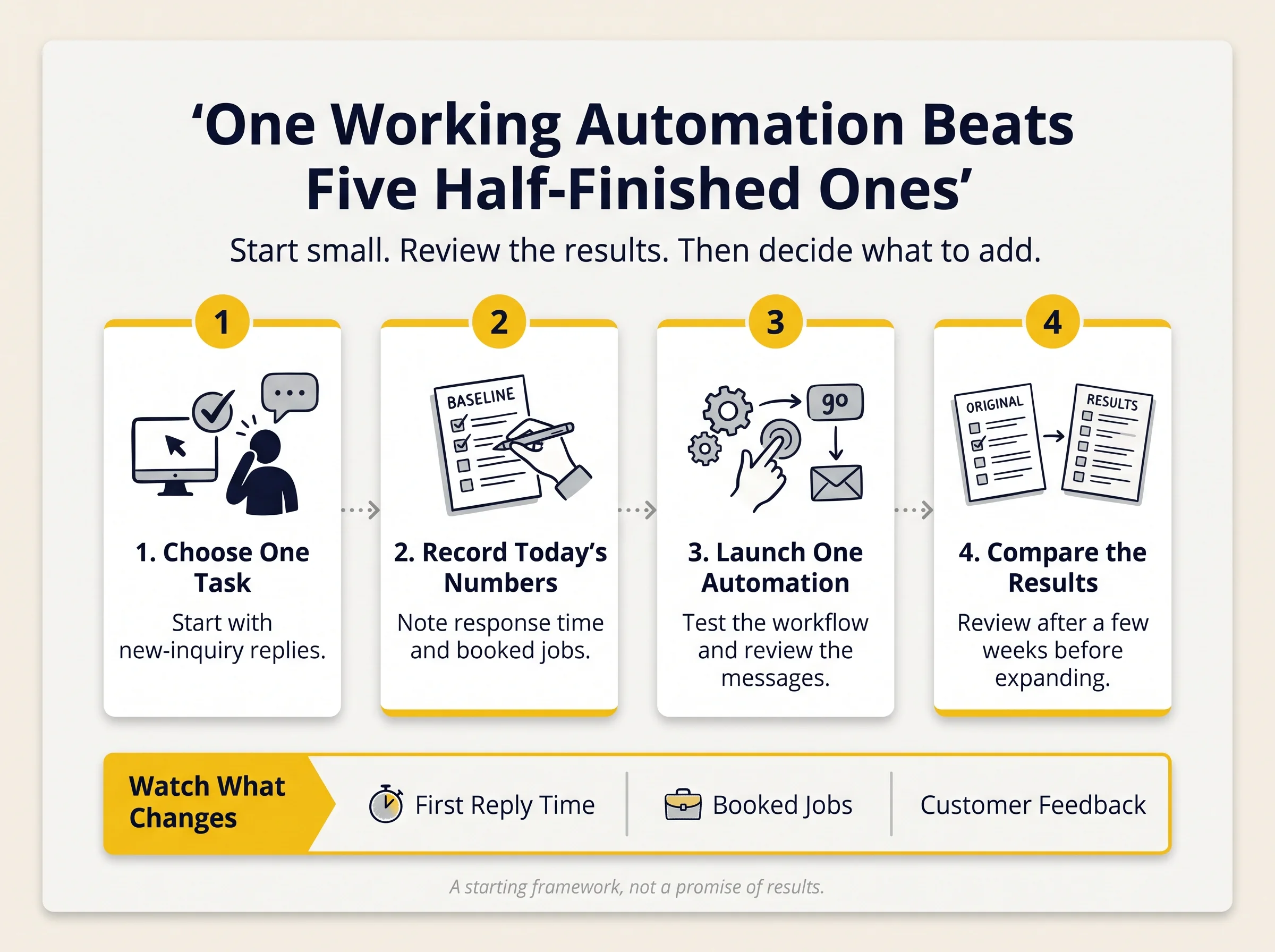
You don't need a big project to begin. A small, careful start teaches you what works for your customers before you spend more time or money. Follow these four steps, and resist the urge to automate everything at once, since one working automation beats five half-finished ones.
Step 1: pick one repeated task, such as replying to new inquiries
Step 2: write down today's numbers, including response time and booked jobs
Step 3: turn on one automation for that task and review the messages yourself
Step 4: compare results after a few weeks, then decide what to add next
Stay Honest and Get Permission First
Automated messages still need permission. Customers should opt in before you send marketing texts or emails, and every message should make opting out easy. Rules vary by location and message type, so check with a qualified professional about what applies to your business and the areas you serve.
Honesty matters too. If a customer is chatting with an automated assistant, don't present it as a person, and make it easy to reach a real one. Handle personal details with care, hold only what a customer expects you to have, and keep sensitive information out of automated messages.
Let GrokOn Set It Up, Test It, and Run It
If you'd rather have help, GrokOn handles the whole thing. Our AI and automation team sets up your first workflows, writes and tests every message, and tracks the results with you, so the first month is about learning what works instead of fixing mistakes after customers have already seen them.
Everything runs on our Smart CRM, so each lead, reply, and booking lives in one record. And when a conversation needs a human, it goes straight to your team with the full history attached. You get the speed of automation without losing the personal touch your customers expect.
Get Your First Automation Running in Three Steps
Book a strategy call. We'll look at how leads reach you today and find the slowest handoff.
Start with one workflow. We set up and test the automation closest to revenue, usually lead response, and review every message with you.
Add more as it proves itself. Once the first workflow is working, we add reminders, review requests, and seasonal follow-up.
Picture a Tuesday night six months from now. A homeowner reaches out at nine, hears back in a minute, and books a morning visit without anyone picking up a phone. Review requests go out after every job, past customers return each season, and you finally stop worrying about leads slipping away.
Want to see where AI marketing automation could help your St. Louis area business first? Book a strategy call and our team will review how leads reach you today, find the slowest handoff, and recommend one practical place to start with AI and automation for small business.
Get Straight Answers to Common Questions
What's the difference between marketing automation and AI marketing automation?
Marketing automation follows rules a person writes, like sending an email two days after a form is submitted. AI marketing automation adds prediction, so the system helps pick the message, channel, and timing for each contact and adjusts as results come in. Many businesses use both together.
Will AI replace my marketing team?
It replaces tasks, not people. Replies, reminders, and reports can run on their own, but strategy, relationships, and quality control still need a person. For a small business, the usual result is that your team spends less time on repetitive work and more time on customers and judgment calls.
Do I need technical skills to use it?
Not usually. AI marketing automation for small business typically runs on templates and simple settings, and a provider can handle the setup. What you do need is clarity about your process: who gets contacted, what you want them to do, and when a person should take over. The technology is the easy part.
How long until I see results?
Faster replies show up right away, since customers notice the difference on day one. Bookings and reviews usually take a few weeks to show a pattern, and meaningful trends take a couple of months. Judge results on response time, booked jobs, and customer feedback, and adjust the messages as you learn.

Find Out What This Looks Like for Your Industry
We help businesses simplify marketing, automation, and AI so they can grow with clarity — not chaos.


© 2026 GrokOn Marketing. All Rights Reserved.