blogs
Insights, Strategies & Systems to Grow Your Business

How to Choose a Digital Marketing Agency in St. Louis (A No-Nonsense Checklist)
Search "best digital marketing agency St. Louis" and you'll get a dozen different "top 10" lists. Half of them are paid placements. None of them tell you anything useful about how these agencies actually operate. You'll see logos, stock photos of people pointing at charts, and a lot of vague promises about "driving results."
None of that helps you make an actual decision.
If you're a St. Louis business owner trying to hire a digital marketing agency in St. Louis, you don't need another ranked list. You need a way to tell a good agency from a mediocre one before you sign a contract, not six months into it after you've already spent the budget.
Here's the checklist.
Why This Decision Is Harder Than It Looks in St. Louis
St. Louis has no shortage of agencies. Some are boutique creative shops. Some are legacy full-service firms that have been around for decades. Some are one-person operations running out of a home office with a nice-looking website. On paper, most of them look about the same: a services page listing SEO, paid ads, social media, and web design, a handful of client logos, and a contact form.
The differences that actually matter don't show up on the homepage. How they think about your business. What happens after a campaign launches. Who ends up owning your data. You have to know what to ask.
That's especially true if you're comparing a marketing agency in St. Louis, MO against a national chain or a freelancer. Price alone won't tell you which one is the better fit. The questions below will.
The No-Nonsense Checklist
1. Do they talk about systems, or just campaigns?
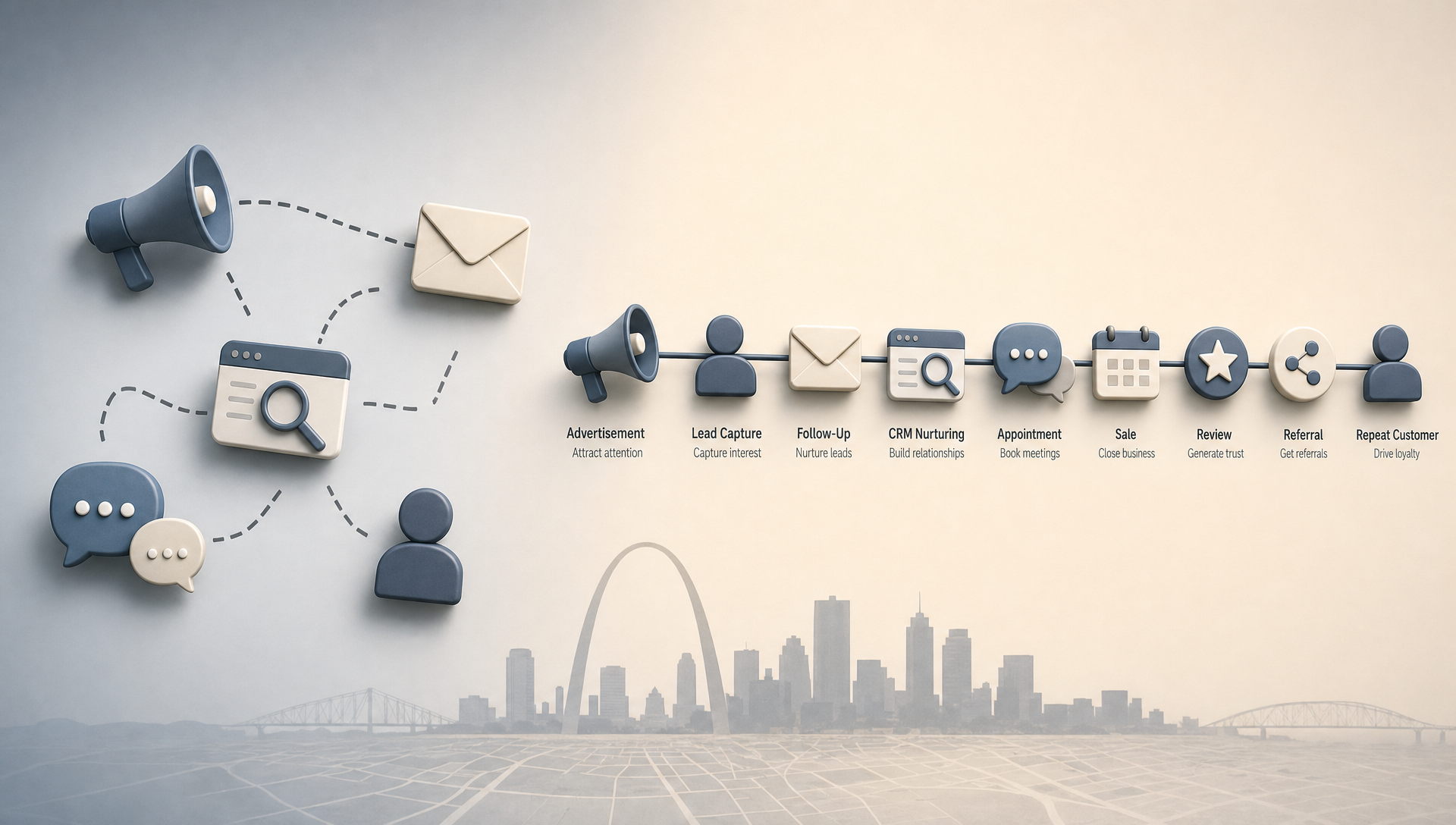
Ask an agency what they'll do for you and pay attention to the shape of the answer. If everything they describe is a campaign (a batch of ads, a boosted post, a one-time email blast) that's worth noting. Campaigns start and stop. Leads that come in during a campaign and go nowhere afterward are usually a sign of an agency that thinks in bursts instead of systems.
A stronger answer sounds less like "we'll run some ads" and more like "here's how a lead moves from seeing your ad to becoming a customer, and here's what happens at each step." That's the difference between marketing that spikes and fades and marketing that keeps compounding.
2. Can they show real results for a business like yours?
Anyone can show you a logo wall. Ask instead: "Can you show me before-and-after numbers for a client in my industry or a similar size?" A credible agency should be able to walk you through actual metrics: leads generated, cost per lead, conversion rate. Not just "we increased their visibility."
If the answer is vague, or it pivots to talking about awards and creative work instead of numbers, take note of that.
3. Who actually owns your accounts and your data?

This is the one most business owners forget to ask, and it's the one that costs the most when they find out too late. Some agencies build your ad accounts, your CRM, and your analytics under their own logins. If you ever part ways, you can lose access to your own customer data, ad history, and tracking overnight.
Before signing anything, ask directly: "If we ever stop working together, do I keep full ownership and access to my accounts?" The answer should be a plain yes.
4. What happens after the campaign launches?

This is where a lot of agencies quietly stop delivering value. The ad goes live, the lead comes in, and then what? Does someone follow up within minutes, or does the lead sit in an inbox for two days? Is there an automated sequence nurturing that lead, or does everything depend on someone remembering to call back?
A marketing agency in St. Louis, MO worth hiring should have a real answer for what happens in the minutes and days after someone raises their hand, and not just how they got that hand raised in the first place.
5. How do they report results?
Ask to see a sample report. If it's full of impressions, reach, and engagement rate with no mention of leads, cost per lead, or revenue impact, you're looking at vanity metrics. Those numbers can look great in a monthly PDF while your phone still isn't ringing.
Good reporting ties back to the numbers that actually affect your business: leads, qualified leads, cost per acquisition, and closed revenue where it's trackable.
6. Is there a real local presence, or is "St. Louis" just a landing page?
Plenty of agencies target every metro in the country with a template page that swaps out the city name. That's not automatically disqualifying, but it's worth knowing. A team that actually understands the St. Louis market, its competition, local search behavior, and local customer expectations, can often make sharper decisions than one running the same playbook in fifty different cities.
Red Flags to Walk Away From
A few patterns are worth treating as hard stops rather than minor concerns:
Long lock-in contracts with no visibility into your own ad accounts. If you can't log in and see your own data, that's a problem.
No mention of follow-up or nurturing. Just ad spend and lead volume, with nothing about what happens to those leads afterward.
Reporting that never mentions leads or revenue. Only reach and impressions.
Reluctance to share specific, verifiable results from past or current clients.
None of these on their own is automatically disqualifying. Two or more together is a signal to keep looking.
What "Systems, Not Just Campaigns" Actually Looks Like
The strongest answer to nearly every question above comes down to one idea: marketing built as a connected system outperforms marketing built as a series of disconnected campaigns.
A lead comes in from an ad. A system follows up automatically within minutes instead of days. That lead gets the right message at the right time, whether or not a person happens to be watching the inbox in that moment. And the results, tied to actual leads and revenue rather than clicks, get reported back in a way you can act on.
That's the model behind how we approach digital marketing at GrokOn, pairing the marketing that gets attention with the automation that makes sure nothing falls through the cracks afterward. It's a useful lens to apply to any agency you're evaluating, not just us.
Quick Self-Check Before You Sign Anything

Before you sign a contract with any digital marketing agency in St. Louis, make sure you can answer yes to these:
Can they show real, specific results for a business like mine?
Do I retain full ownership of my accounts and data?
Is there a clear plan for what happens after a lead comes in?
Will reporting show me leads and revenue instead of just impressions?
Do they understand systems rather than one-off campaigns?
If you can't get a straight answer to any of these, that's information too.
Frequently Asked Questions
How much does a digital marketing agency in St. Louis typically cost?
Costs vary widely based on scope. A single-service engagement, like paid ads management alone, often starts lower than a full-service package that includes SEO, content, automation, and reporting. Get a scope-specific quote rather than comparing agencies on a single flat number.
What's the difference between a marketing agency and a marketing automation partner?
A traditional agency typically focuses on getting attention through ads, content, and SEO. An automation-focused partner also builds the systems that follow up with and nurture the leads that attention generates. The strongest results tend to come from agencies that do both.
How long should I commit to before expecting results?
Paid ads can show early signals within weeks. SEO and organic content typically take three to six months to show meaningful movement. Be cautious of any agency promising dramatic SEO results in under a month.
Ready to see what a systems-first approach to marketing looks like for your business? Get in touch with GrokOn to talk through where your current marketing might be leaving leads on the table.

Find Out What This Looks Like for Your Industry
We help businesses simplify marketing, automation, and AI so they can grow with clarity — not chaos.


© 2026 GrokOn Marketing. All Rights Reserved.