Reviews, Referrals, and Loyalty Software Built for Service Businesses
Three systems that turn a finished job into the next one. Built around how service work actually happens, and run by our team instead of yours.
You already do good work. The problem is what happens after it. The referral never gets tracked, the review never gets asked for, and the customer who was delighted in March has forgotten you by September.
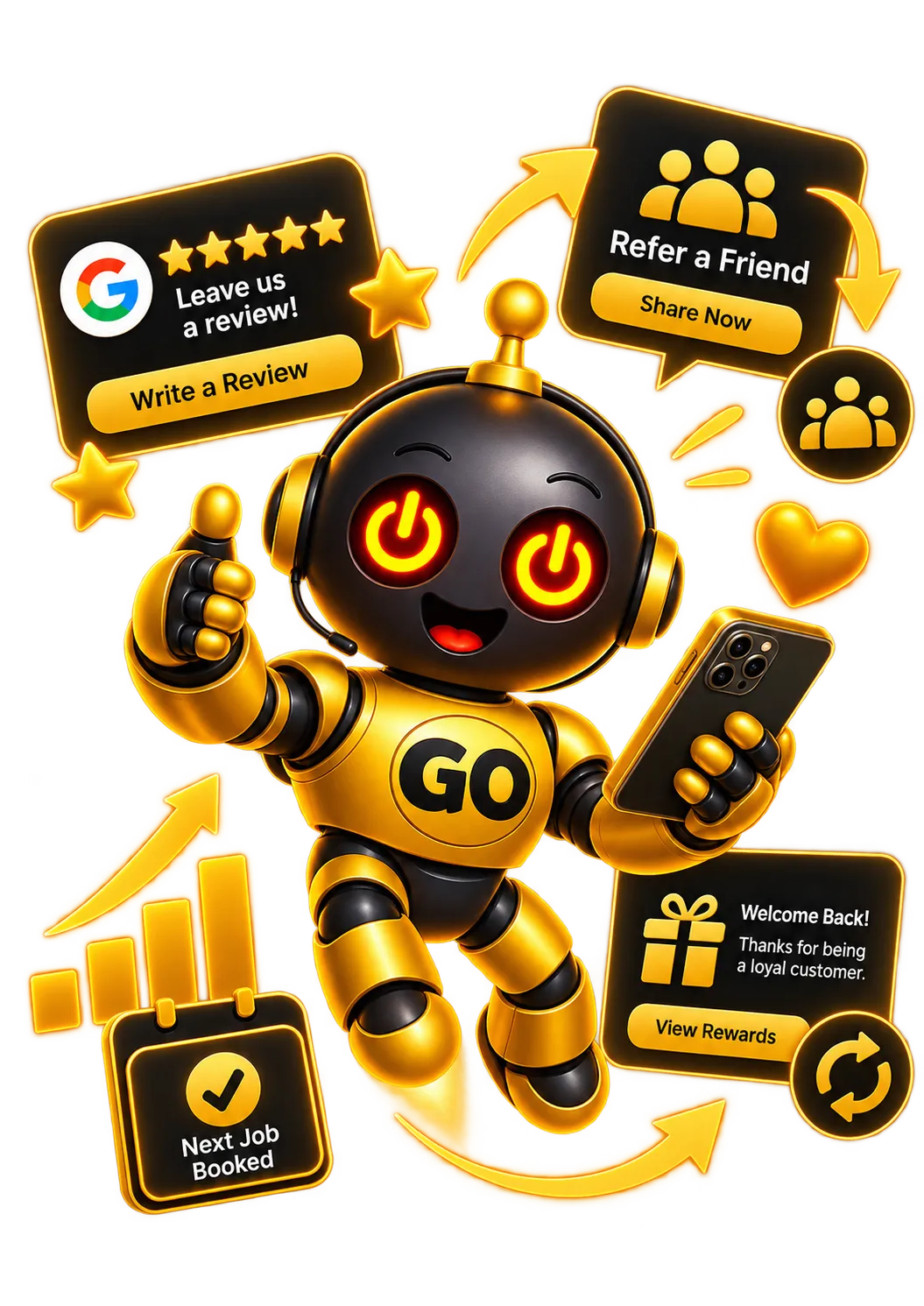
GROBridge handles the part of the business that currently runs on somebody remembering. Referrals get captured and attributed. Reviews get requested at the right moment. Repeat customers get a reason to come back.
Most of these tools were built for online stores
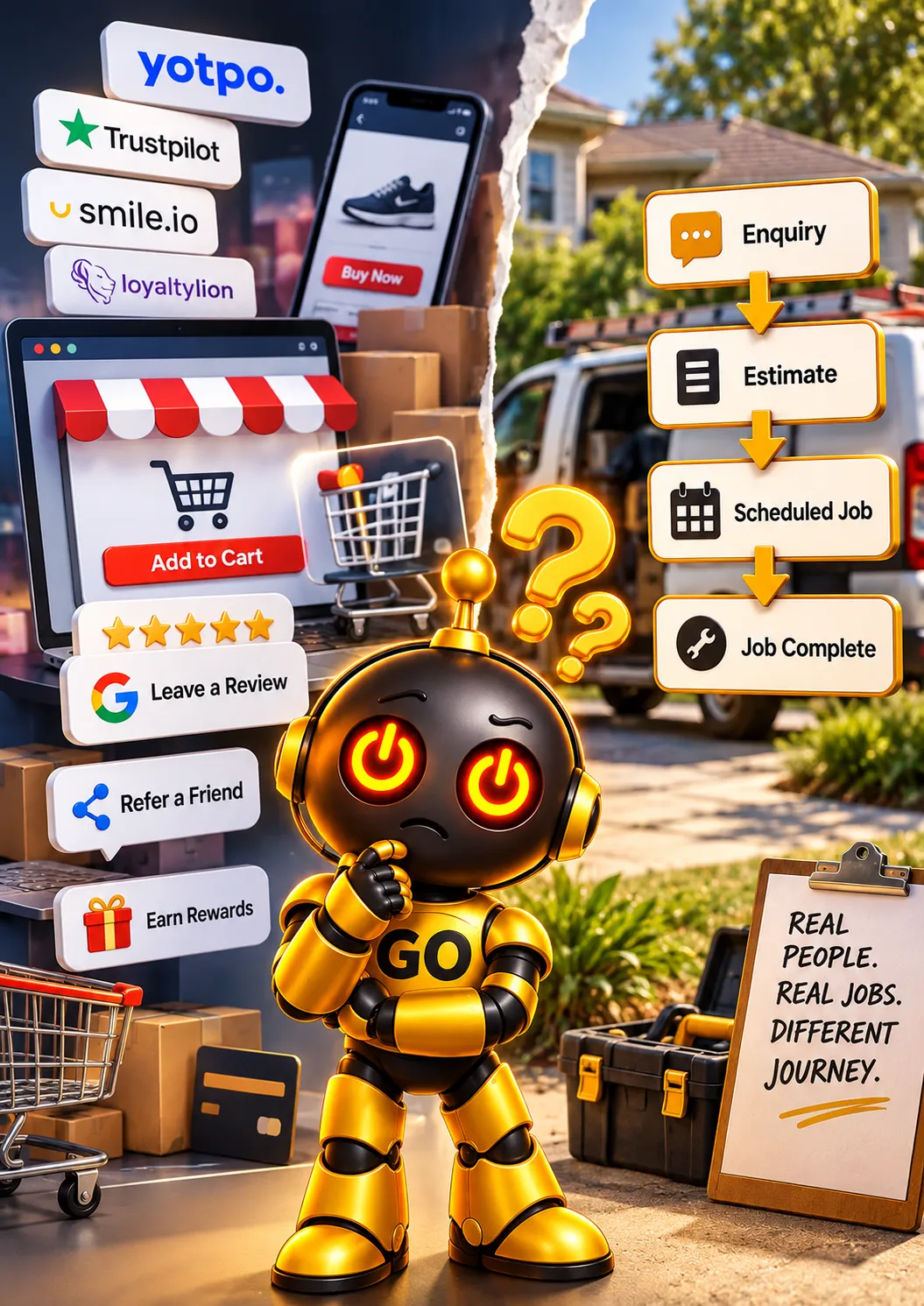
Look at the referral, review and loyalty platforms on the market and a pattern shows up fast. They were designed around a purchase that happens on a website, in one session, with a link the customer can share at checkout.
Service work does not look like that. An enquiry becomes an estimate, the estimate becomes a scheduled job, the job gets done weeks later. There is no checkout moment, and your customer is standing in a driveway, not on a product page.
Referrals are the sharpest example of the mismatch, which is why we start there.
ReferGRO: make word of mouth something you can actually see
Nearly every service business says it grows on word of mouth. Almost none can tell you who referred whom last quarter, how many of those referrals turned into work, or what the channel is actually worth.
The problem with referral software
Most referral platforms track a shared link. Someone clicks it, buys, and the system records the credit. That works when the whole transaction happens online in a single session.
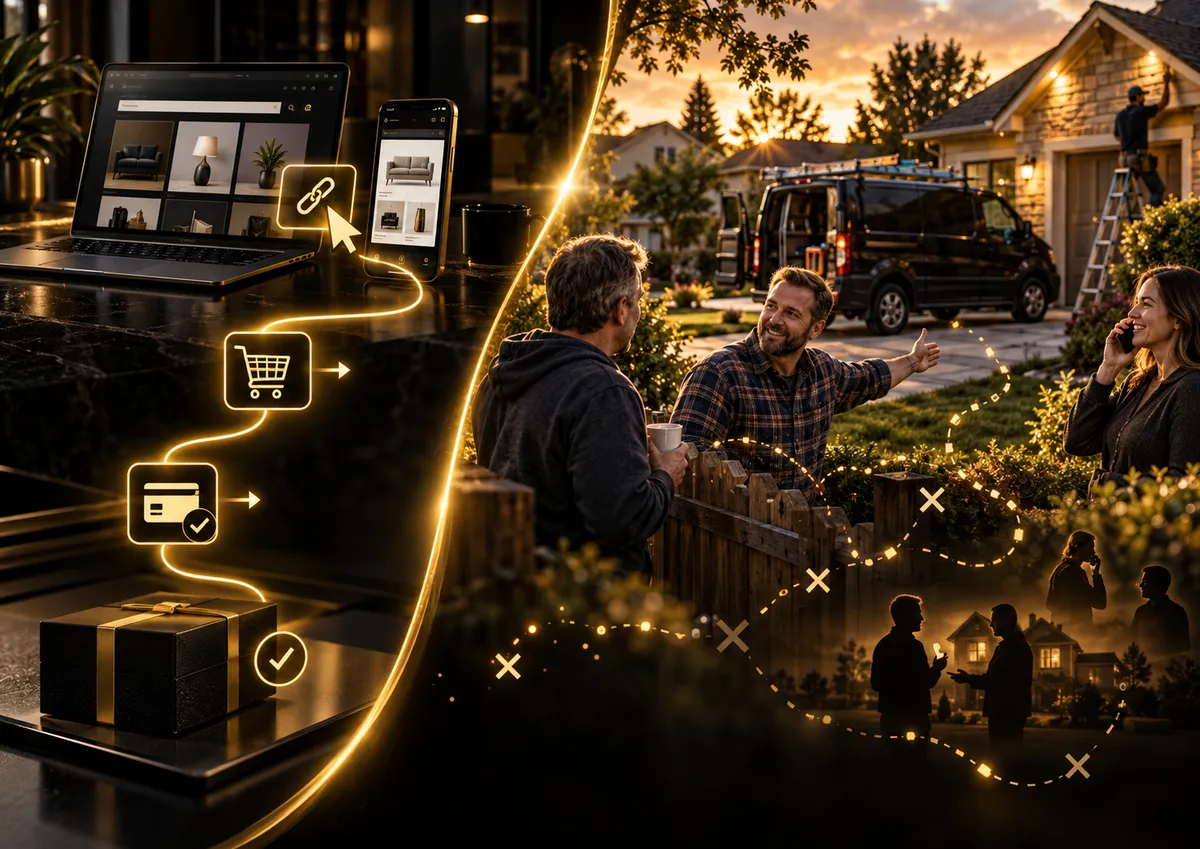
Your referrals do not arrive that way. They happen at a job site, over a fence, or in a phone call between neighbours who have never seen your website. A system built on link tracking records almost none of your real referral volume.
What ReferGRO does differently
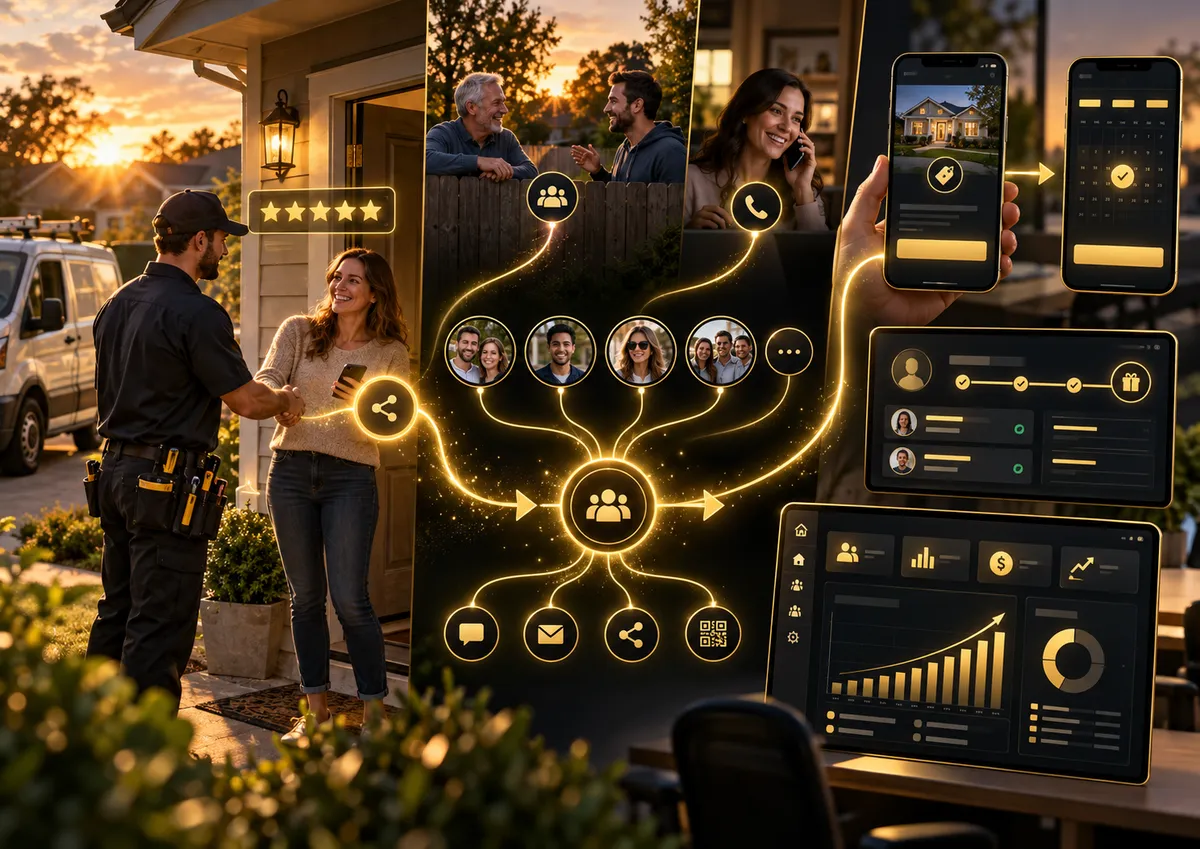
The ask goes out at the natural moment, after a completed job or a positive review, when goodwill is highest. Customers can refer one to one or share more broadly, whichever suits how they actually talk about you.
Every referral is tracked back to the person who made it, including the ones that started offline. Rewards reach the right customer, and you finally get a number for a channel that has always been invisible.
Referred prospects land on a claim page that leads to a booking, rather than a name on a sticky note. Both you and your customers get a dashboard. They see where their referrals stand. You see which ones became revenue.
ReviewGRO: turn finished work into visible proof
Most businesses do not have a review problem. They have a consistency problem. Customers are happy, they mean to leave a review, and then life happens and nobody follows up.
ReviewGRO asks at the right moment, follows up when nobody responds, and makes leaving a review a few taps on a phone. Customers are routed to the platforms that matter most for your visibility.
What happens when someone is not happy
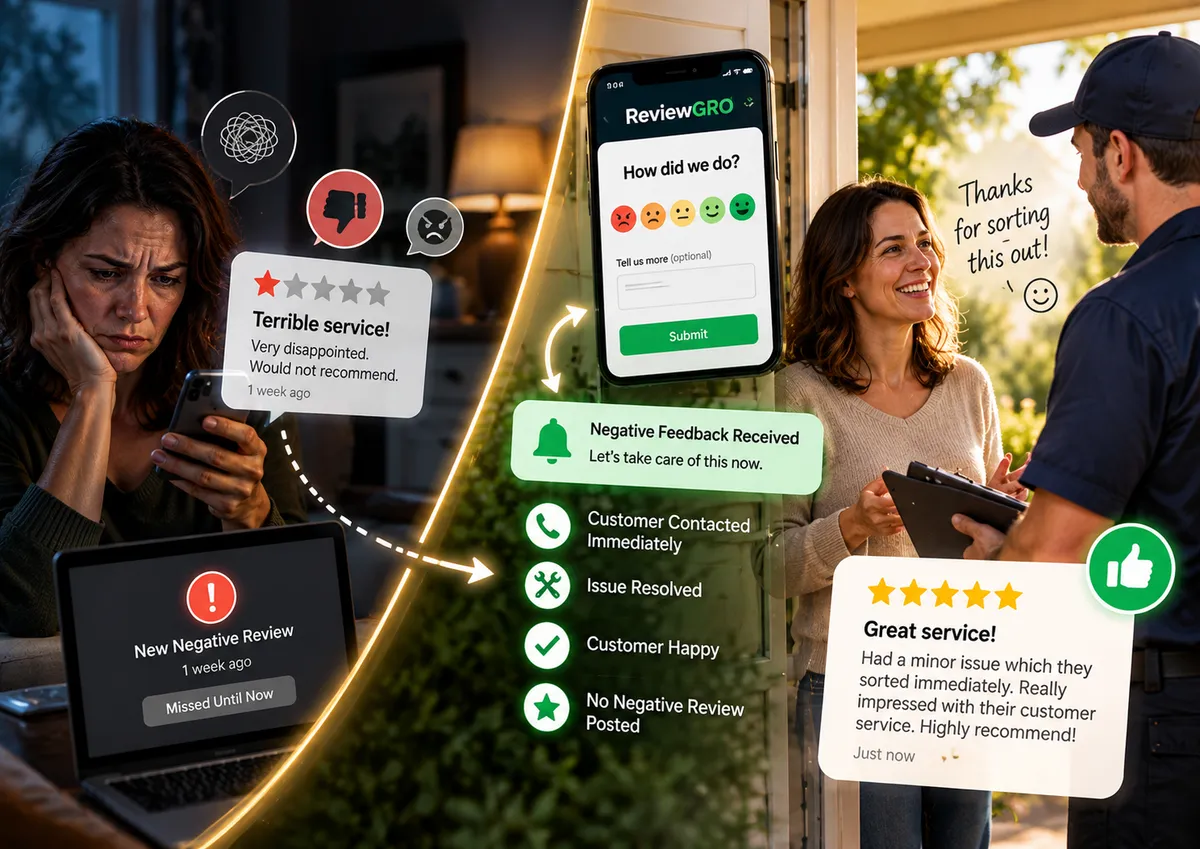
Not every job ends well, and the businesses that handle that badly are the ones with a one-star review they only discovered a week later.
ReviewGRO collects satisfaction feedback as part of the flow, so you hear about a problem directly and early. That gives you a chance to put it right while the customer is still talking to you rather than about you.

What about the review requests built into your job software?
Worth addressing directly, because it is the honest comparison. Most field service platforms now send a review request when a job is marked complete, and if you already pay for one of those, it costs you nothing extra.
For some businesses that is genuinely enough. If review volume is your only gap and the built-in tool is firing reliably, use it. We would rather tell you that than sell you a second system that does the same job.
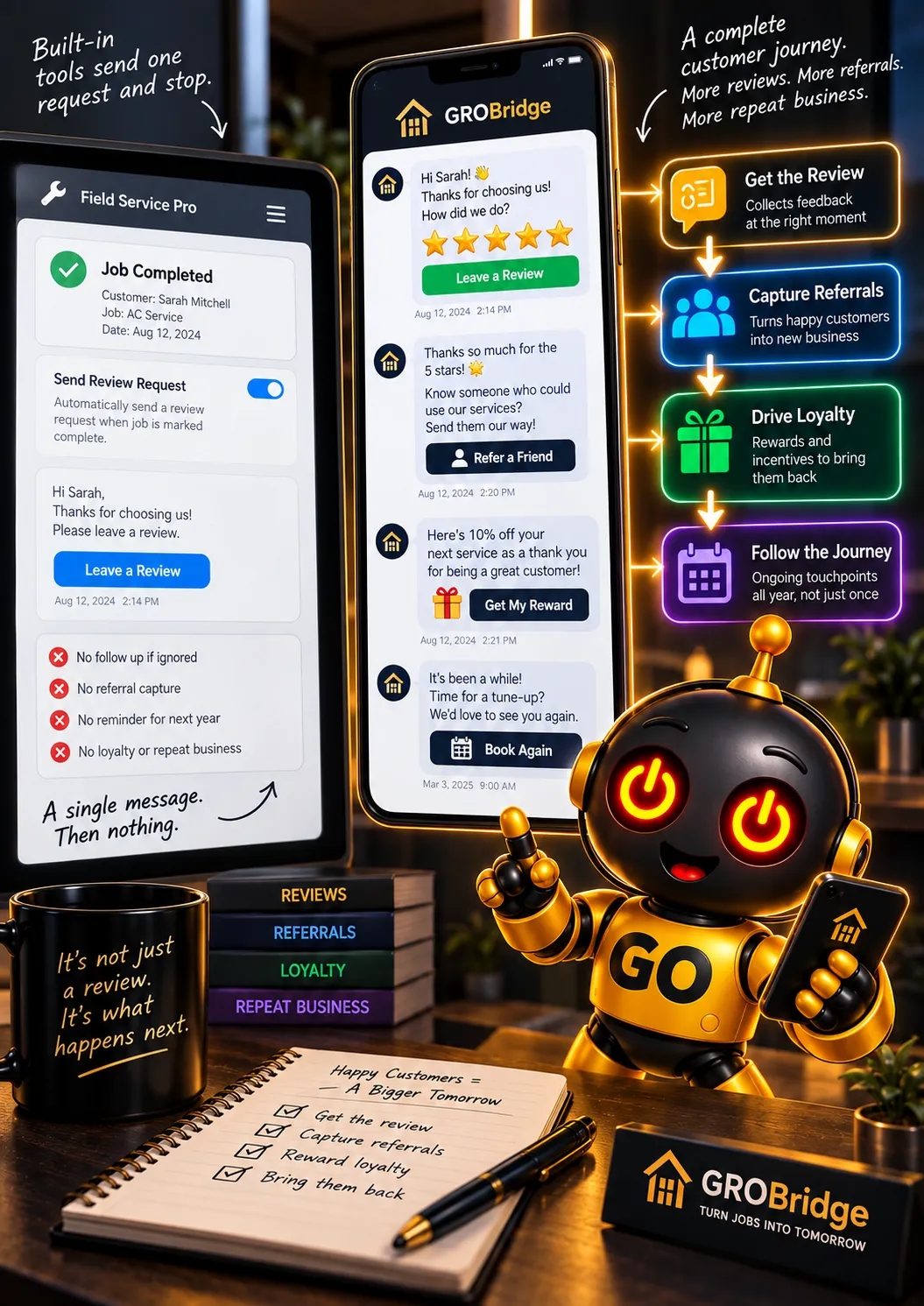
Where it stops being enough is when the ask is the only thing happening. Built-in tools send one request and stop. They do not follow up with the people who ignored it, they do not chase the referral that a five-star review just created, and they do not bring anyone back next year.
The value here is not a better review request. It is the sequence that runs after it.
LoyaltyGRO: give customers a reason to come back sooner
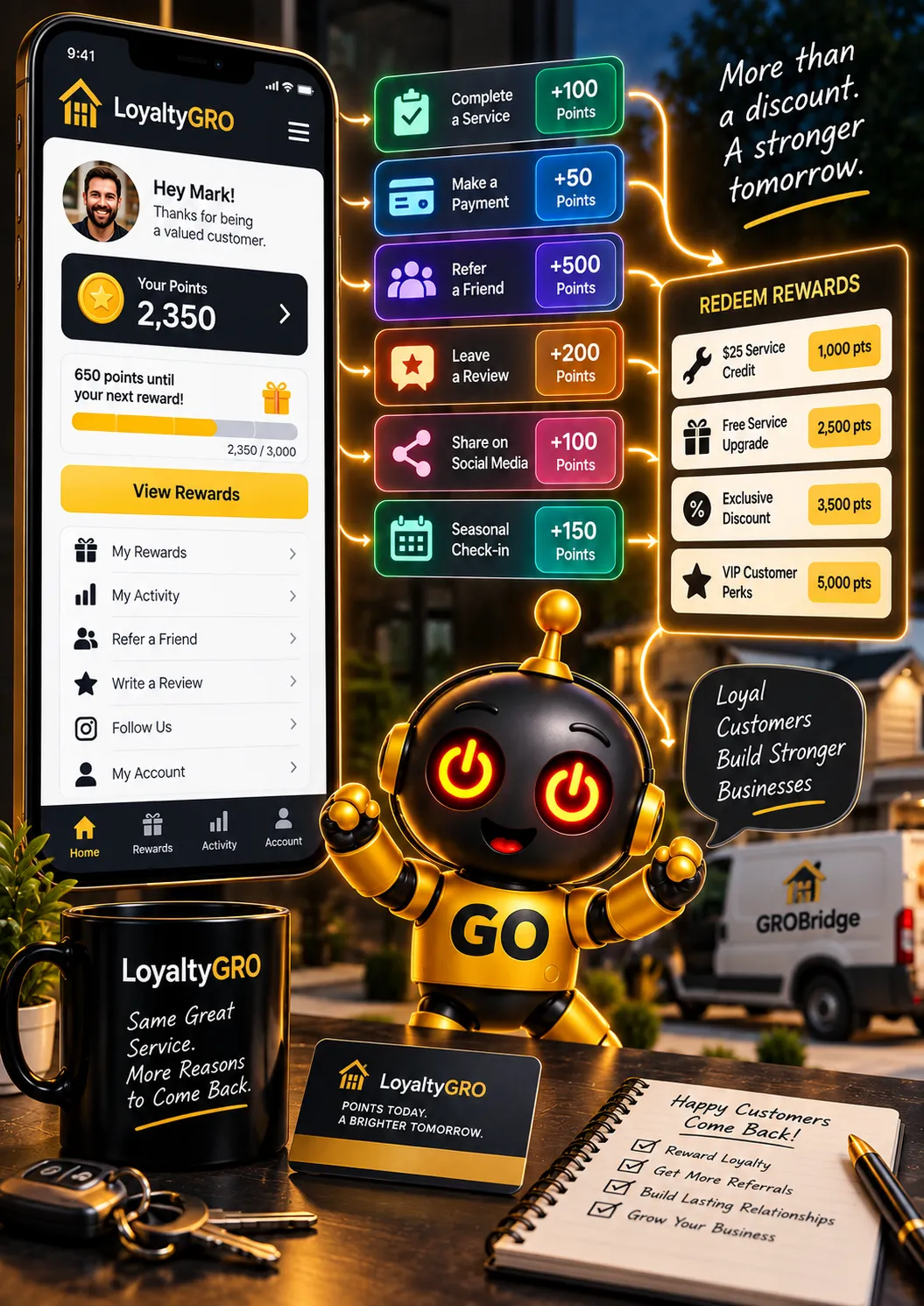
A punch card and an occasional discount is not a retention system. LoyaltyGRO is a points and rewards engine that attaches value to the behaviours that actually grow the business.
Points for purchases and payments, yes. But also for referrals, reviews, social shares, and whatever else matters to you. You set the redemption levels, run promotions and vouchers, and let follow-up and redemption run on their own.
Most loyalty platforms assume a point of sale to attach to. Service businesses working out of trucks do not have one, which is why so many of these programmes never get off the ground in the trades.
Customers get their own login and dashboard, so they can see what they have earned and what it is worth. Visible progress is most of what makes a loyalty programme work at all.
Buy one, or run all three
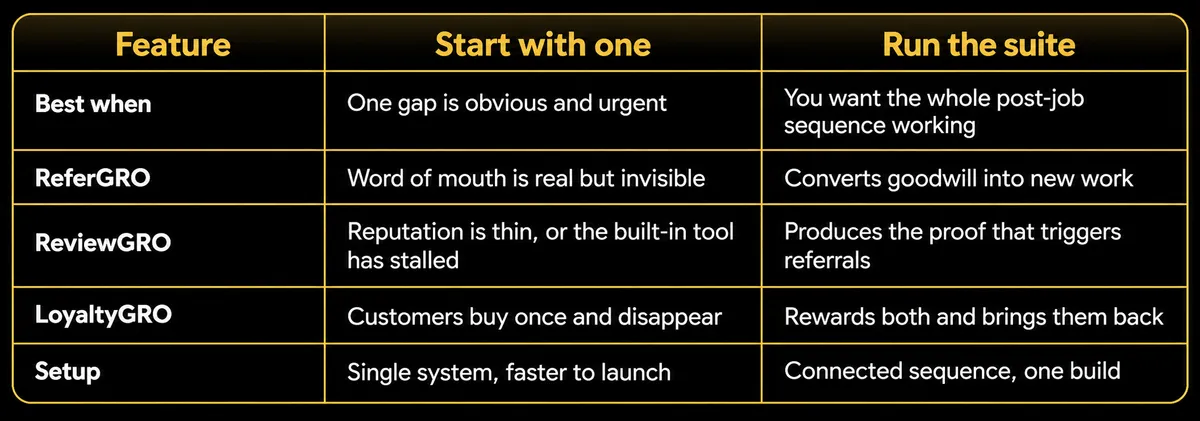
Each system works on its own. Referrals are usually the fastest to show a return, because the goodwill already exists and nothing is currently capturing it. Reviews are the most visible gap. Loyalty compounds slowest and lasts longest.
Run together, they feed each other. A completed job produces a review, the review moment is when the referral gets asked for, and the loyalty programme rewards both. Each step triggers the next instead of sitting in a separate tool with a separate login.
Built and run by our team
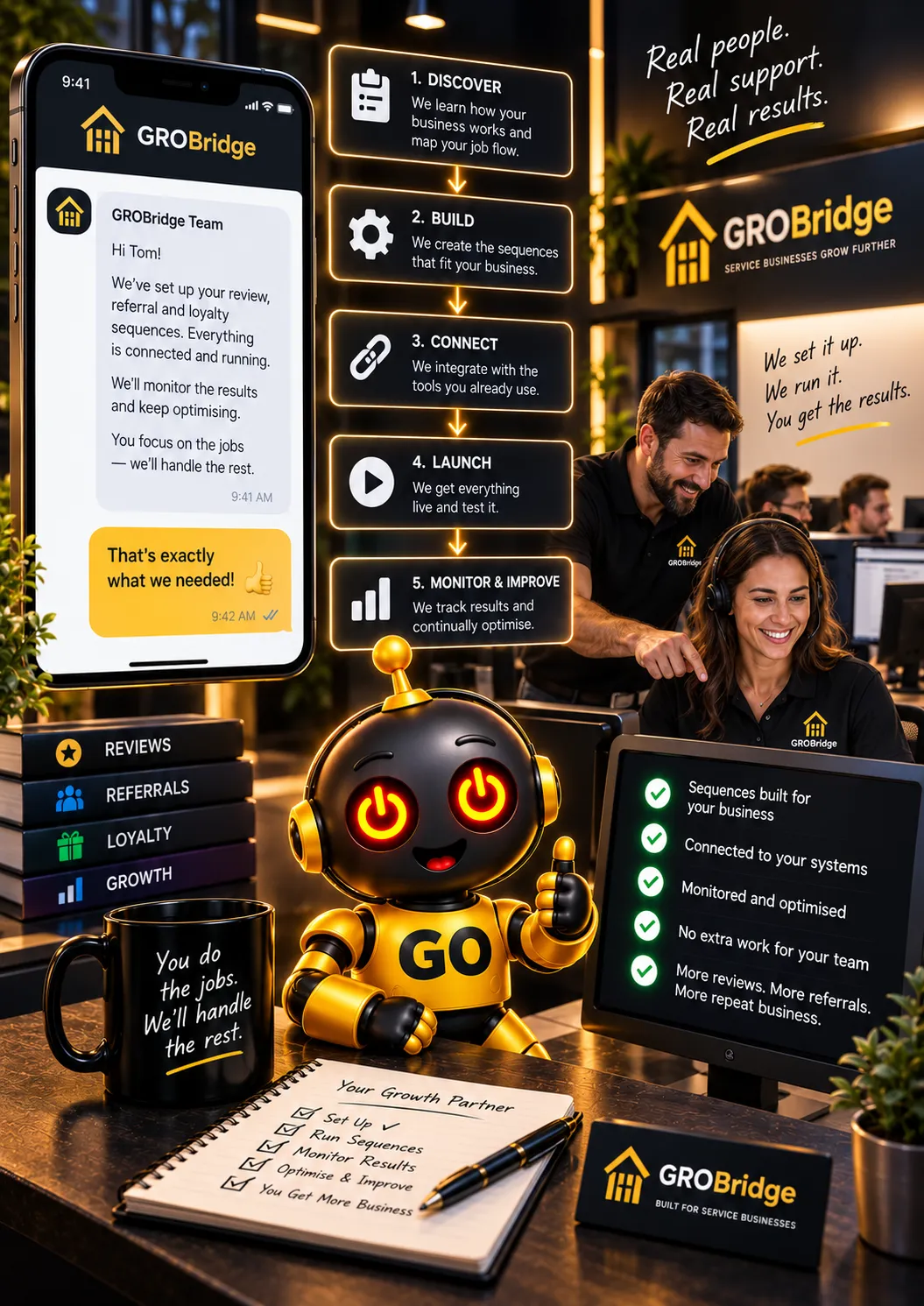
This is what separates GROBridge from software you could sign up for this afternoon. Those tools are yours to configure, yours to maintain, and yours to fix when an automation quietly stops firing and nobody notices for a month.
We build the sequences around how your business actually finishes a job. We connect them to the systems you already run. We watch the results after launch and adjust the timing, the wording and the triggers based on what the responses show.
Nobody on your team becomes the person who manages this. That matters more than it sounds. A review request sequence nobody is watching degrades from an asset into an irritation your customers remember.
How this relates to AnswerGRO
Two different problems, and it is worth knowing which one you have.
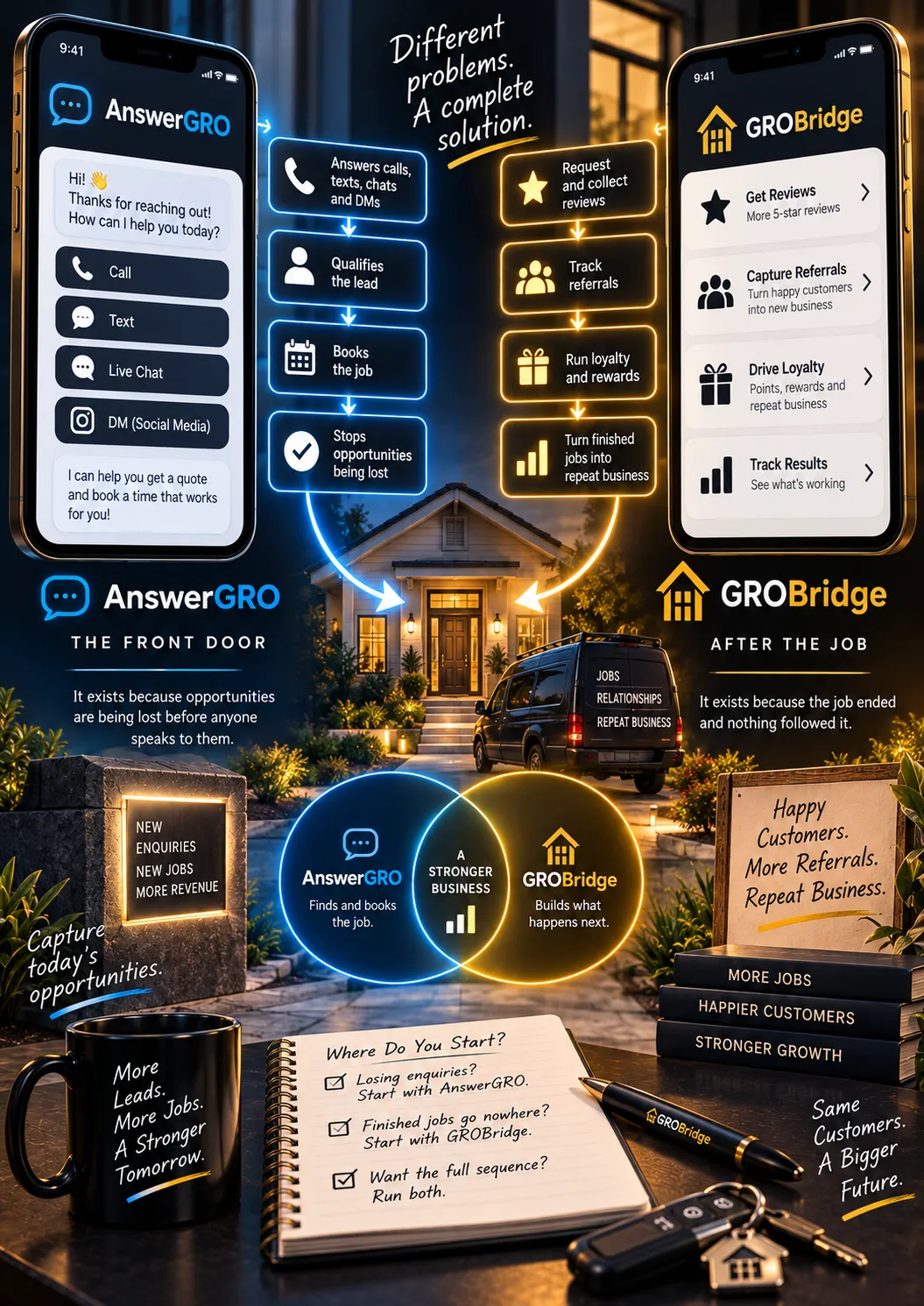
AnswerGRO is the front door. It answers calls, texts, chats and DMs, qualifies the lead, and books the job. It exists because opportunities are being lost before anyone speaks to them.
GROBridge is what happens after the work is finished. Referrals, reviews, and repeat business. It exists because the job ended and nothing followed it.
If you are losing enquiries, start at the front door. If your phones are handled and the problem is that finished jobs go nowhere, start here. Businesses running both get the full sequence, and the components overlap by design.
Who this is for
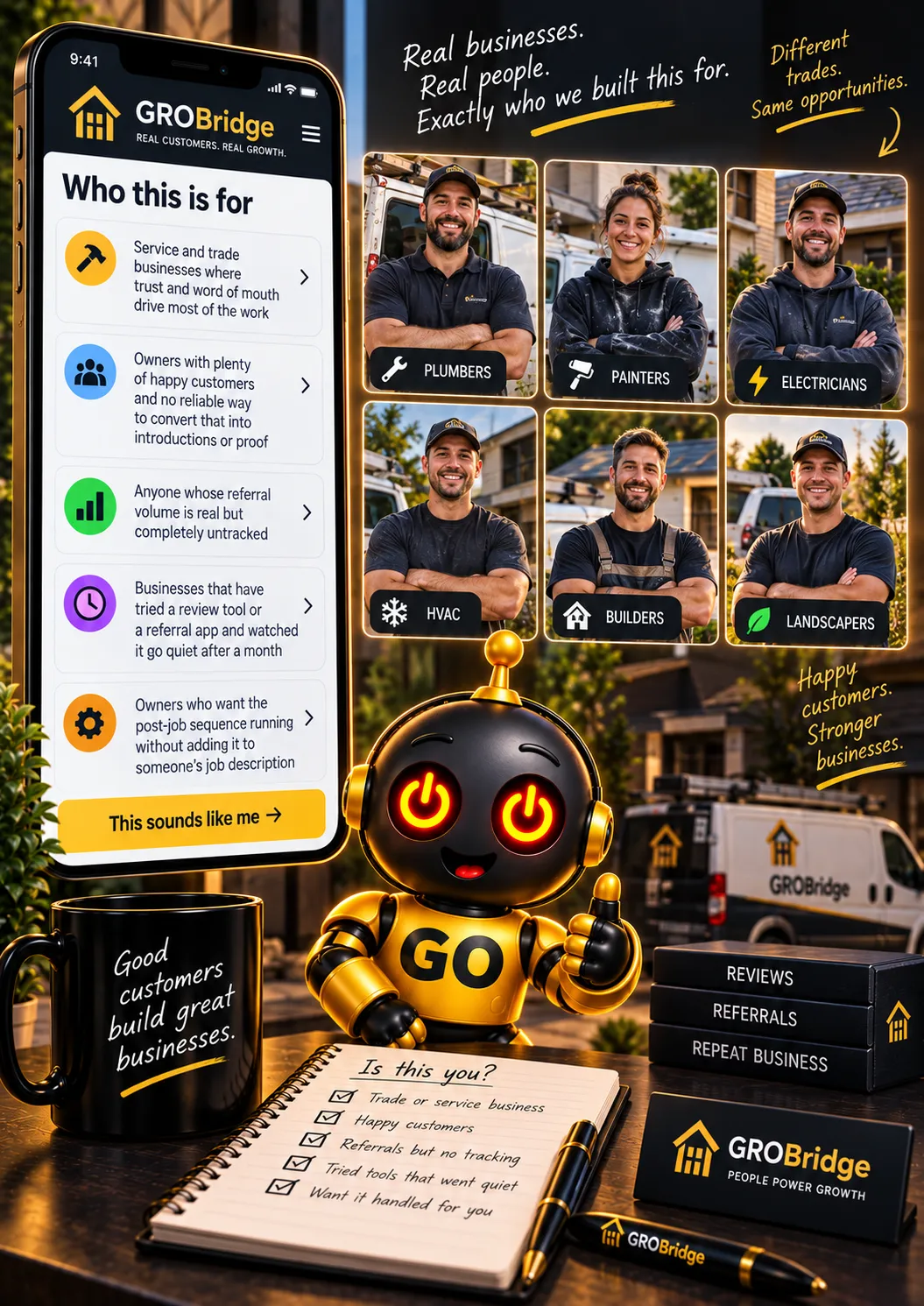
Service and trade businesses where trust and word of mouth drive most of the work
Owners with plenty of happy customers and no reliable way to convert that into introductions or proof
Anyone whose referral volume is real but completely untracked
Businesses that have tried a review tool or a referral app and watched it go quiet after a month
Owners who want the post-job sequence running without adding it to someone's job description

Stop guessing. Start growing.

Speak With Our Team
Common questions
Can I buy just one of the three?
Yes. Each works on its own and most businesses start with one. Referrals are usually the fastest return because the goodwill already exists and nothing is capturing it today.
My job software already sends review requests. Why would I pay for this?
If review volume is your only gap and the built-in tool is working, you probably would not. What it does not do is follow up with people who ignored the first ask, turn a five-star review into a referral, or bring that customer back next year.
Can it really track referrals that happen offline?
That is the point of it, and it is what separates this from platforms built for online stores. Referrals that start at a job site or in a phone call get captured and attributed rather than disappearing into nothing.
How is this different from the review apps I have seen advertised?
Two ways. Most were built for e-commerce and assume a checkout moment your business does not have. And they are self-serve, so configuring and maintaining them is your job. We build these around service work and we run them.
Will asking for reviews and referrals annoy my customers?
Only if the timing and wording are wrong, which is exactly what an unmanaged system gets wrong. The ask goes at the natural moment, follow-up stops when it should, and we adjust based on what responses actually show.
Does this work with the software we already use?
It connects to what you run. Where a system has no native connection, our integration team builds one.
How long before we see anything?
Referrals and reviews move first, usually within weeks, because you already have a backlog of satisfied customers to work with. Loyalty compounds more slowly, since it depends on customers moving through a full cycle.
What does it cost?
Not something we answer with a number on a web page, because it depends on which systems you run and how your business is set up. It gets mapped for you in the strategy session, before you commit to anything.
Your best customers are already willing to help
They will make the introduction, leave the review, and come back sooner. What is missing is a system that asks at the right moment and keeps track of what happened afterward.
The strategy session maps which of the three would move fastest in your business, and what running it would involve.
We help businesses simplify marketing, automation, and AI so they can grow with clarity — not chaos.


© 2026 GrokOn Marketing. All Rights Reserved.